
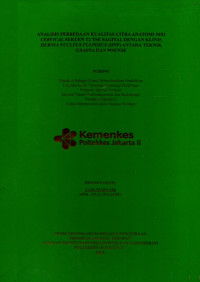
Skripsi
ANALISIS PERBEDAAN KUALITAS CITRA ANATOMI MRI CERVICAL SEKUEN T2 TSE SAGITAL DENGAN KLINIS HERNIA NUCLEUS PULPOSUS (HNP) ANTARA TEKNIK GRAPPA DAN MSENSE
ABSTRACTrnrnBACHELOR OF APPLIED SCIENCE PROGRAMrnIMAGING RADIOLOGY TECHNOLOGY STUDY PROGRAM rnRADIODIAGNOSTICS AND RADIOTHERAPY DEPARTMENTrnHEALTH POLYTECHNIC OF HEALTH MINISTRY rnJAKARTA IIrnrnTHESIS, 2025rnYADI MARYADIrnrnrnANALYSIS OF DIFFERENCES IN ANATOMICAL IMAGE QUALITY OF SAGITTAL T2 TSE CERVICAL MRI IN THE PATIENTS WITH CLINICAL HERNIA NUCLEUS PULPOSUS (HNP) BETWEEN GRAPPA AND MSENSE TECHNIQUESrnrnV Chapters + 63 Pages + 30 Figures + 26 Tables + 15 AppendicesrnrnResearch Background : In cervical MRI examinations, the sagittal T2 Turbo Spin Echo (TSE) sequence is available and routinely used. In this matter, this sequence is capable of demonstrating any abnormal anatomical findings, including among the other things spondylolisthesis, subluxation, vertebral bodies, intervertebral discs, the spinal cord, cerebrospinal fluid, and pathological conditions such as herniated nucleus pulposus (HNP). In relation to which, the selection of imaging parameters in cervical MRI also serves as a determinant of examination duration (scanning time). The patients are generally more comfortable when the examination is completed within a shorter scanning time. The scanning time on Siemens MRI systems can be minimized through the use of available techniques, namely parallel imaging techniques such as GRAPPA (k-space–based reconstruction) and mSENSE (image-space–based reconstruction). The parallel imaging techniques GRAPPA and mSENSE employ different methods for MRI diagnostic image reconstruction; however, the both are similarly effective in accelerating MRI scanning time.rnResearch Objective : This research aims to analyse the differences in anatomical image quality and to determine which parallel imaging technique GRAPPA or mSENSE is more optimal for visualizing anatomical structures, including the spinal cord (medulla spinalis), cerebrospinal fluid, intervertebral discs, vertebral bodies, and the pathology of herniated nucleus pulposus (HNP).rnResearch Design: This research employed a quantitative analytic method with an experimental approach to compare the quality of diagnostic anatomical image information in cervical MRI. The research involved a total of 10 patients as the primary data samples, which were selected based on the defined inclusion and exclusion criteria, and was undertaken at Murni Teguh Sudirman Hospital, Jakarta.rnResearch Results: As the results, this research demonstrated that there is a difference in the anatomical image quality of herniated nucleus pulposus (HNP) pathology on sagittal T2 TSE sequences. The GRAPPA parallel imaging technique was found to be more optimal in visualizing anatomical image quality information of HNP pathology, with a higher mean rank value of 5.00, compared to the mSENSE parallel imaging technique, which yielded a mean rank value of 0.00.rnrnrnKeywords: Cervical MRI; Sagittal T2 TSE; Scanning Time; Parallel Imaging; GRAPPA; mSENSE.rnTranslated by:rnrnrnrnrnrnrnSuhendar, S.S., M.Pd.rnEnglish Lecturer
Ketersediaan
Informasi Detail
- Judul Seri
-
-
- No. Panggil
-
001.43 YAD a
- Penerbit
- Jakarta : Jurusan Teknik Radiodiagnostik dan Radioterapi., 2026
- Deskripsi Fisik
-
xiv + 110pages: illustration; 21 x 29cm.
- Bahasa
-
Indonesia
- ISBN/ISSN
-
-
- Klasifikasi
-
001.43
- Tipe Isi
-
-
- Tipe Media
-
-
- Tipe Pembawa
-
-
- Edisi
-
-
- Subjek
- Info Detail Spesifik
-
-
- Pernyataan Tanggungjawab
-
Yadi Maryadi
Versi lain/terkait
Tidak tersedia versi lain
Lampiran Berkas
Komentar
Anda harus masuk sebelum memberikan komentar
 Karya Umum
  Filsafat
  Agama
Agama  Ilmu-ilmu Sosial
  Bahasa
  Ilmu-ilmu Murni
  Ilmu-ilmu Terapan
  Kesenian, Hiburan, dan Olahraga
  Kesusastraan
  Geografi dan Sejarah