
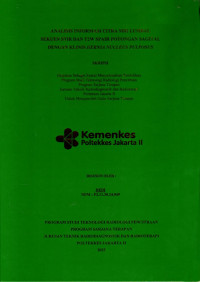
Skripsi
ANALISIS INFORMASI CITRA MRI LUMBAL SEKUEN STIR DAN T2W SPAIR POTONGAN SAGITAL DENGAN KLINIS HERNIA NUCLEUS PULPOSUS
ABSTRACTrnrnBACHELOR OF APPLIED SCIENCE PROGRAM IMAGING RADIOLOGY TECHNOLOGY STUDY PROGRAM RADIODIAGNOSTICS AND RADIOTHERAPY DEPARTMENTrnHEALTH POLYTECHNIC OF HEALTH MINISTRY rnJAKARTA IIrnrnTHESIS, 2025rnDEDIrnrnANALYSIS OF IMAGE INFORMATION IN SAGITTAL LUMBAR SPINE MRI USING STIR AND T2-WEIGHTED SPAIR SEQUENCES IN THE PATIENTS WITH HERNIATED NUCLEUS PULPOSUSrnrnV Chapters +40 Pages + 11 Figures + 7 Tables + 13 AppendicesrnrnResearch Background: Purposefully, this research focus on Magnetic Resonance Imaging (MRI) which constitutes the primary imaging modality for the evaluation of Herniated Nucleus Pulposus (HNP). Furthermore, in lumbar spine MRI examinations, fat suppression techniques such as Short Tau Inversion Recovery (STIR) and T2-weighted Spectral Adiabatic Inversion Recovery (T2W SPAIR) play an important role in enhancing the visualization of anatomical structures. However, these techniques have different fat suppression characteristics, which may result in the variations in the quality of image information visualization.rnResearch Objective: This research aims to determine the differences in sagittal lumbar spine MRI image information between the STIR and T2-weighted SPAIR sequences in the patients with Herniated Nucleus Pulposus.rnResearch Design: This research applied a quantitative method with a comparative approach. As for the research, it was undertaken at Radiology Department of Welas Asih Regional General Hospital, West Java Province, starting from November up to December 2025. While the study sample consisted of 10 patients with a clinical diagnosis of Herniated Nucleus Pulposus.rnResearch Results: As the results, this research demonstrated that the STIR sequence provided greater image information quality compared to the T2-weighted SPAIR sequence in most of the assessed anatomical aspects.rnrnKeywords : Lumbar MRI, STIR, T2W SPAIR
Ketersediaan
Informasi Detail
- Judul Seri
-
-
- No. Panggil
-
001.43 DED a
- Penerbit
- Jakarta : Jurusan Teknik Radiodiagnostik dan Radioterapi., 2026
- Deskripsi Fisik
-
ii-xiv + -pages: 0 x 0cm.
- Bahasa
-
Indonesia
- ISBN/ISSN
-
-
- Klasifikasi
-
001.43
- Tipe Isi
-
-
- Tipe Media
-
-
- Tipe Pembawa
-
-
- Edisi
-
-
- Subjek
- Info Detail Spesifik
-
-
- Pernyataan Tanggungjawab
-
Dedi
Versi lain/terkait
Tidak tersedia versi lain
Lampiran Berkas
Komentar
Anda harus masuk sebelum memberikan komentar
 Karya Umum
  Filsafat
  Agama
Agama  Ilmu-ilmu Sosial
  Bahasa
  Ilmu-ilmu Murni
  Ilmu-ilmu Terapan
  Kesenian, Hiburan, dan Olahraga
  Kesusastraan
  Geografi dan Sejarah